Fusion AI vs Runcell

Runcell wins in 2 out of 4 categories.
Rating
Neither tool has been rated yet.
Popularity
Runcell is more popular with 16 views.
Pricing
Runcell is completely free.
Community Reviews
Both tools have a similar number of reviews.
| Criteria | Fusion AI | Runcell |
|---|---|---|
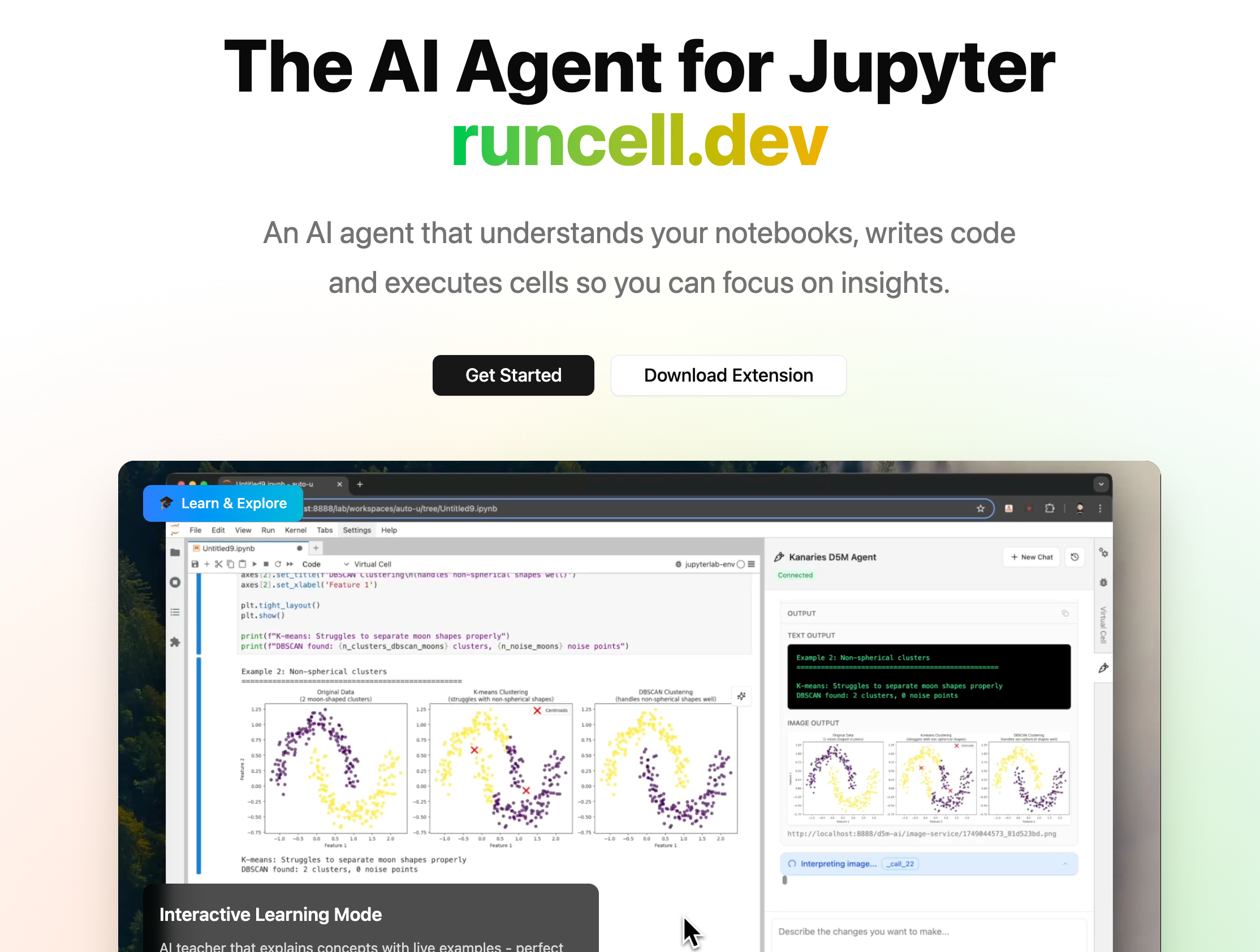
| Description | Fusion AI is a comprehensive AI platform designed to simplify access and integration of leading generative AI models across various content types. It acts as a unified hub, enabling users to generate high-quality text, images, code, and audio without managing multiple subscriptions or interfaces. By consolidating top-tier models like GPT-4, Claude, DALL-E 3, and ElevenLabs, Fusion AI caters to individuals and teams seeking efficiency and versatility in their AI-powered workflows, offering a streamlined approach to content creation and development. | Runcell is an innovative AI agent extension purpose-built for Jupyter Lab, designed to significantly automate and enhance the entire data science and development workflow. It functions as an intelligent assistant that deeply understands the context of a notebook, enabling it to generate accurate code, debug errors, interpret complex results, and streamline analytical tasks. By integrating directly into the Jupyter environment, Runcell empowers data scientists, analysts, and developers to accelerate their work, minimize manual coding, and gain deeper insights with unprecedented efficiency, transforming Jupyter into an AI-powered co-pilot. |
| What It Does | Fusion AI provides a centralized dashboard where users can interact with and leverage multiple state-of-the-art AI models through a single interface. It facilitates the creation of diverse content, from written articles and marketing copy to compelling images, functional code snippets, and realistic audio. The platform abstracts away the complexity of individual model APIs, offering a consistent user experience for various generative tasks. | Runcell integrates directly into Jupyter Lab, observing and understanding the current notebook's context, data, and code. It leverages large language models (LLMs) to generate relevant Python code, identify and suggest fixes for errors, and provide natural language explanations for outputs and visualizations. Users interact with Runcell via a chat interface, prompting it to perform tasks, answer questions, or refine code directly within their existing workflow, making complex data operations more intuitive. |
| Pricing Type | freemium | free |
| Pricing Model | freemium | free |
| Pricing Plans | Free: Free, Starter: 19, Pro: 49 | N/A |
| Rating | N/A | N/A |
| Reviews | N/A | N/A |
| Views | 12 | 16 |
| Verified | No | No |
| Key Features | Multi-Model Integration, Multi-Modal Content Generation, Custom AI Studio, Unified API Access, AI Chat Assistant | N/A |
| Value Propositions | Unified AI Access, Cost-Effective Model Usage, Streamlined Creative & Technical Workflows | N/A |
| Use Cases | Generate Marketing Assets, Accelerate Code Development, Produce Audio Content, Brainstorm & Research, Design Unique Visuals | N/A |
| Target Audience | Fusion AI is ideal for content creators, marketers, developers, small to medium-sized businesses, and agencies who require efficient access to multiple generative AI capabilities. It particularly benefits those looking to streamline their AI tool stack, reduce costs associated with multiple subscriptions, and accelerate content production and software development workflows. | Runcell is primarily designed for data scientists, machine learning engineers, and data analysts who frequently work within Jupyter Lab. It also benefits academic researchers, students, and developers who need to quickly prototype, analyze data, and build models efficiently. Its capabilities are particularly valuable for those looking to automate repetitive coding tasks and accelerate their data-driven workflows. |
| Categories | Text Generation, Image Generation, Code Generation, Audio Generation | Code & Development, Code Generation, Code Debugging, Documentation, Data Analysis, Automation, Research, Data & Analytics, Data Visualization, Data Processing |
| Tags | ai platform, multi-modal ai, generative ai, llm aggregator, image generation, code generation, audio generation, api access, content creation, business productivity, ai studio, team collaboration | N/A |
| GitHub Stars | N/A | N/A |
| Last Updated | N/A | N/A |
| Website | tryfusion.ai | runcell.dev |
| GitHub | N/A | github.com |
Who is Fusion AI best for?
Fusion AI is ideal for content creators, marketers, developers, small to medium-sized businesses, and agencies who require efficient access to multiple generative AI capabilities. It particularly benefits those looking to streamline their AI tool stack, reduce costs associated with multiple subscriptions, and accelerate content production and software development workflows.
Who is Runcell best for?
Runcell is primarily designed for data scientists, machine learning engineers, and data analysts who frequently work within Jupyter Lab. It also benefits academic researchers, students, and developers who need to quickly prototype, analyze data, and build models efficiently. Its capabilities are particularly valuable for those looking to automate repetitive coding tasks and accelerate their data-driven workflows.