
Runcell
Last updated:
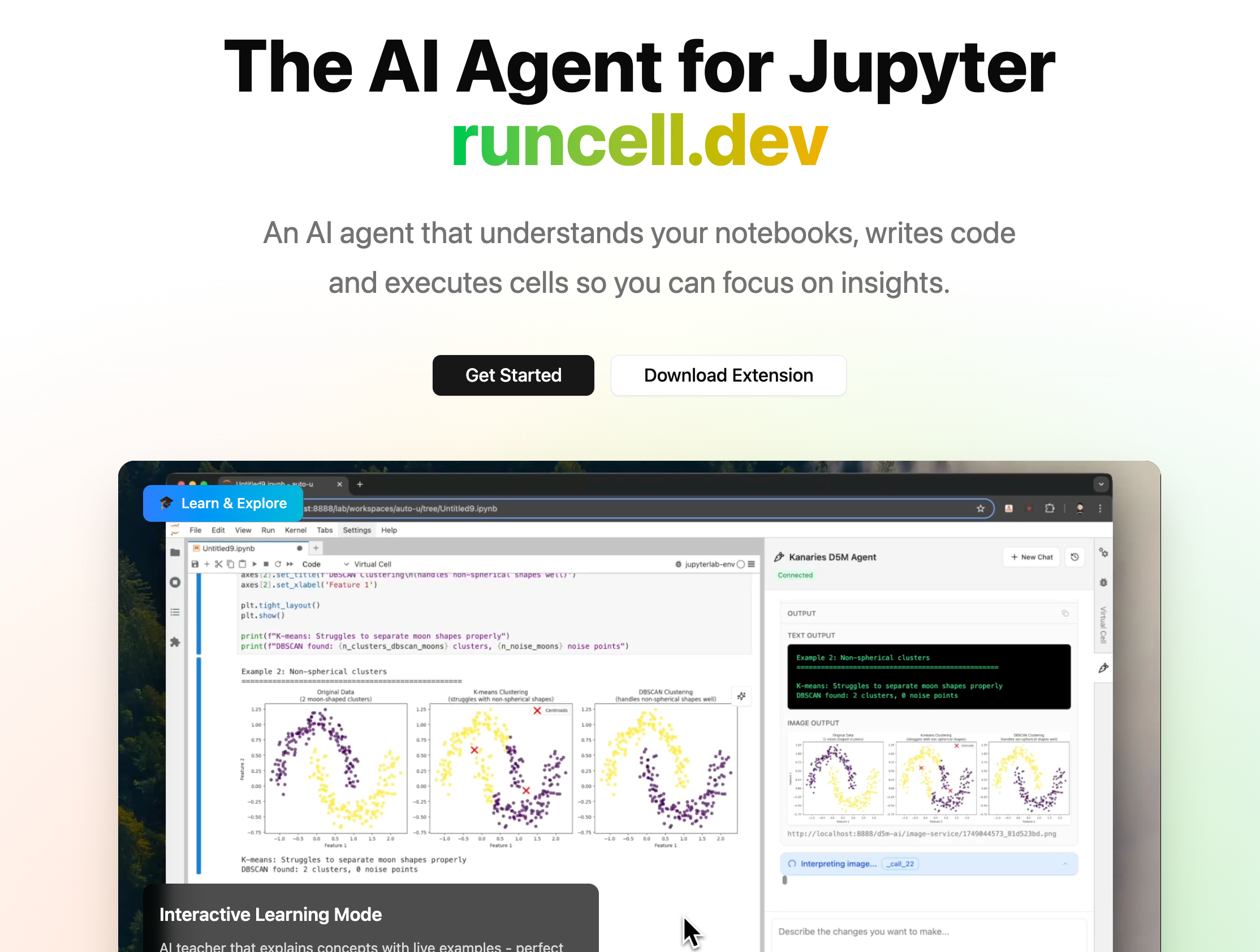
Runcell is an innovative AI agent extension purpose-built for Jupyter Lab, designed to significantly automate and enhance the entire data science and development workflow. It functions as an intelligent assistant that deeply understands the context of a notebook, enabling it to generate accurate code, debug errors, interpret complex results, and streamline analytical tasks. By integrating directly into the Jupyter environment, Runcell empowers data scientists, analysts, and developers to accelerate their work, minimize manual coding, and gain deeper insights with unprecedented efficiency, transforming Jupyter into an AI-powered co-pilot.
What It Does
Runcell integrates directly into Jupyter Lab, observing and understanding the current notebook's context, data, and code. It leverages large language models (LLMs) to generate relevant Python code, identify and suggest fixes for errors, and provide natural language explanations for outputs and visualizations. Users interact with Runcell via a chat interface, prompting it to perform tasks, answer questions, or refine code directly within their existing workflow, making complex data operations more intuitive.
Pricing
Key Features
Runcell distinguishes itself with its deep contextual understanding of Jupyter notebooks, allowing it to generate highly relevant code and provide insightful interpretations. Its real-time debugging capabilities help users quickly resolve issues, while its ability to explain complex data outputs and visualizations democratizes understanding. The seamless integration and interactive chat interface make it an intuitive and powerful tool for accelerating data science tasks and reducing development friction, ultimately boosting productivity and insight generation.
Target Audience
Runcell is primarily designed for data scientists, machine learning engineers, and data analysts who frequently work within Jupyter Lab. It also benefits academic researchers, students, and developers who need to quickly prototype, analyze data, and build models efficiently. Its capabilities are particularly valuable for those looking to automate repetitive coding tasks and accelerate their data-driven workflows.
Value Proposition
Runcell's unique value lies in its deep, contextual integration directly into Jupyter Lab, transforming it into an AI-powered co-pilot for data science. It significantly reduces the time spent on mundane coding, debugging, and interpretation, allowing users to focus on higher-level problem-solving and insights. By automating these critical steps, Runcell empowers users to achieve more with less effort, making complex data tasks more accessible and efficient for everyone.
Use Cases
Automating data cleaning, performing exploratory data analysis, generating machine learning model code, debugging scripts, documenting notebooks, and rapid prototyping.
Frequently Asked Questions
Yes, Runcell is completely free to use.
Runcell integrates directly into Jupyter Lab, observing and understanding the current notebook's context, data, and code. It leverages large language models (LLMs) to generate relevant Python code, identify and suggest fixes for errors, and provide natural language explanations for outputs and visualizations. Users interact with Runcell via a chat interface, prompting it to perform tasks, answer questions, or refine code directly within their existing workflow, making complex data operations more intuitive.
Runcell is best suited for Runcell is primarily designed for data scientists, machine learning engineers, and data analysts who frequently work within Jupyter Lab. It also benefits academic researchers, students, and developers who need to quickly prototype, analyze data, and build models efficiently. Its capabilities are particularly valuable for those looking to automate repetitive coding tasks and accelerate their data-driven workflows..


Get new AI tools weekly
Join readers discovering the best AI tools every week.