

Best Mypaste Alternatives
Discover 24 alternatives to Mypaste. Compare features, pricing, and ratings to find the perfect replacement.

AI For Developers
AI For Developers is a free, expertly curated online directory meticulously designed for software engineers and tech professionals. Its core purpose is to simplify the integration of advanced AI into development workflows by uniquely mapping diverse AI solutions directly to specific stages of the Software Development Lifecycle (SDLC). This platform acts as an indispensable resource, dramatically streamlining the discovery and adoption of contextually relevant AI technologies, ultimately aiming to significantly elevate developer productivity and efficiency through precise tool selection across every project phase.
 0
0
 43
43
OPT
OPT (Open Pre-trained Transformer) is a pioneering family of open-source large language models (LLMs) developed by Meta AI and made readily accessible through the Hugging Face platform. This initiative champions transparency and the democratization of advanced AI, offering researchers and developers unparalleled access to LLM architectures ranging from 125 million to an impressive 175 billion parameters. OPT serves as a critical, openly available resource for fostering collaborative progress in open AI science, enabling deep investigations into crucial areas like scaling laws, ethical considerations, and responsible AI development, while also functioning as a vital benchmark within the broader LLM research ecosystem.
0
39
Llama 2
Llama 2 is Meta's groundbreaking open-source large language model, designed for both extensive research and broad commercial applications. It offers a suite of pre-trained and fine-tuned (Llama 2-Chat) models across diverse parameter sizes (7B, 13B, 70B), providing unparalleled flexibility for developers and businesses to build innovative natural language processing solutions. Its accessibility and performance make it a cornerstone for next-generation AI development, fostering a vibrant ecosystem of custom AI applications.
0
59

Claude 3
Claude 3 is Anthropic's flagship family of powerful AI models, encompassing Opus, Sonnet, and Haiku, each optimized for different performance needs. Designed as an advanced AI thinking partner, it excels at tackling highly complex problems, conducting sophisticated data analysis, and facilitating robust code generation and debugging. Its standout features include industry-leading reasoning capabilities, comprehensive multimodal understanding (text and vision), and a strong commitment to ethical AI and safety standards, making it invaluable for both individual users and large enterprises seeking to significantly enhance productivity and innovation.
0
44

Vicuna 13b
Vicuna 13b is a prominent open-source chatbot model, meticulously fine-tuned from Meta's LLaMA architecture using a vast dataset of user-shared conversations from ShareGPT. It stands out for its exceptional instruction-following capabilities and ability to maintain coherent, multi-turn dialogues, generating high-quality, human-like text. This model is ideal for developers and researchers seeking a powerful yet accessible foundation for diverse conversational AI applications, offering a strong alternative to proprietary large language models for prototyping and deployment.
0
42
Stable Beluga 2
Stable Beluga 2 is a highly capable 70B parameter large language model, developed by Stability AI and finetuned from Meta's Llama 2 architecture. It stands out for its enhanced performance across a wide array of natural language understanding and generation tasks, making it a robust foundation for sophisticated AI applications. This model is particularly valuable for developers and researchers seeking a powerful, accessible, and instruction-tuned LLM.
0
42

GPT 4o Mini
GPT-4o Mini is OpenAI's highly anticipated, cost-efficient, and fast multimodal AI model, designed to make advanced AI capabilities accessible to a broader audience. As a foundational model, it excels at understanding and generating content across text, image, and potentially audio modalities, all while offering significantly lower operational costs compared to its larger counterparts. This model empowers developers and businesses to integrate sophisticated AI reasoning into a wide array of applications without incurring prohibitive expenses, fostering innovation and scalability.
0
43
ChatSonic
ChatSonic by Writesonic is an advanced AI conversational assistant designed to be a versatile content creation and information retrieval tool. It combines real-time data access, powered by Google Search, with robust text and image generation capabilities, making it an all-in-one solution for diverse content needs. Users can interact with it conversationally to draft various types of content, answer questions with up-to-date information, and instantly create unique digital images, effectively functioning as a comprehensive AI co-pilot within the broader Writesonic ecosystem.
0
41
Phind
Phind is an AI-powered search engine and intelligent pair programmer meticulously crafted for software developers. It delivers immediate, contextually rich, and highly relevant answers to complex technical queries, complete with executable code examples and verifiable source citations. This tool significantly streamlines development workflows, accelerates problem-solving, and empowers developers to build faster and more efficiently by minimizing context switching and providing instant expertise directly within their workflow.
0
46
Gali Chat
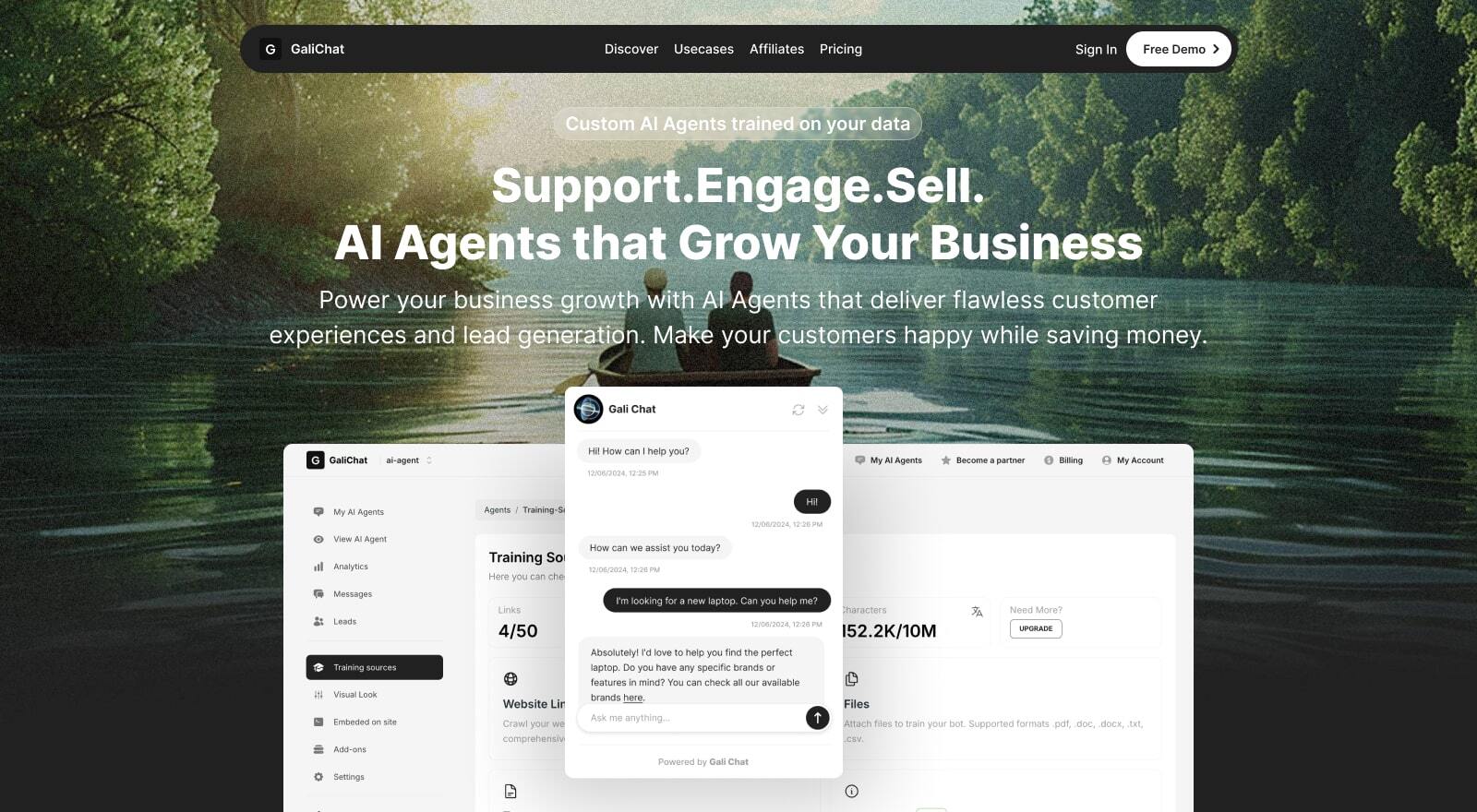
Gali Chat is a robust 24/7 AI support assistant specifically engineered to foster business growth through continuous, intelligent assistance. It offers comprehensive capabilities for effortlessly generating high-quality text, unique images, and functional code, serving a wide array of business operations and content creation needs. This versatile tool aims to significantly enhance overall productivity, streamline workflows, and provide an always-on AI companion for businesses seeking to scale and innovate across various departments.
0
45
ChatGPT for Jupyter
ChatGPT for Jupyter is an open-source Jupyter Notebook and Jupyter Lab extension that seamlessly integrates AI-powered helper functions, primarily leveraging OpenAI's ChatGPT, directly into the user's coding environment. Designed for data scientists, developers, and researchers, it significantly enhances productivity by allowing users to generate, explain, debug, and refactor code, analyze data, and summarize information without ever leaving their Jupyter workspace. This tool stands out by embedding sophisticated AI capabilities contextually within the notebook, streamlining workflows and accelerating development.
0
62
Chatbot UI
Chatbot UI is a robust, open-source, and local-first web interface designed to serve as a private and highly customizable alternative to commercial large language model (LLM) chat applications like ChatGPT. It empowers users with full control over their data and chat experience by allowing local storage of conversations and settings, ensuring privacy and data sovereignty. This tool stands out for its extensive support for various LLM providers and local models, combined with a flexible architecture that supports plugins and deep customization, making it ideal for privacy-conscious individuals, developers, and teams seeking a self-hosted AI chat solution.
0
37

Forefront
Forefront is an advanced AI chat platform providing users with free and unlimited access to leading large language models like OpenAI's GPT-4 and Anthropic's Claude 3 (Opus, Sonnet, Haiku), alongside powerful image generation capabilities from DALL-E 3 and Stable Diffusion XL. It distinguishes itself by offering these premium AI tools without cost, wrapped in an enhanced chatbot experience featuring custom personas, persistent instructions, and robust chat management features. This makes it an attractive hub for individuals seeking diverse and powerful AI assistance for creative, professional, and personal tasks, democratizing access to cutting-edge artificial intelligence.
0
102

Google Sheets Formula Generator
The Google Sheets Formula Generator by Better Sheets is an AI-powered tool that translates natural language requests into precise Google Sheets formulas. Designed to significantly boost user productivity, it eliminates the need for users to recall complex syntax or scour documentation, making advanced spreadsheet functions accessible to both beginners and experienced data handlers. This tool streamlines data manipulation and analysis, allowing users to focus on insights rather than formula construction, thereby enhancing efficiency and reducing errors in spreadsheet management.
0
42

Pieces
Pieces is an AI-enabled productivity suite designed specifically for developers, serving as an on-device copilot that deeply integrates into their daily workflow. It empowers developers to seamlessly capture, enrich, and reuse code snippets, links, and text, fostering efficient knowledge management and problem-solving. By leveraging on-device AI, Pieces provides contextual understanding of development tasks, streamlines collaboration, and significantly boosts individual and team productivity, making it a powerful tool for modern software development.
0
29

Mocha
Mocha is an innovative AI app builder that empowers users to swiftly create functional, full-stack web applications from simple natural language prompts. It intelligently automates the entire development process, from frontend UI to backend logic and database design, making app creation accessible and significantly faster for both technical and non-technical individuals. By leveraging AI, Mocha aims to democratize app development, enabling rapid prototyping and deployment without the need for extensive coding expertise.
0
45

Ollama
Ollama is an innovative open-source platform designed to simplify the process of running large language models (LLMs) like Llama 2, Mistral, and Gemma directly on personal computers. It provides a streamlined experience for downloading, managing, and interacting with these powerful AI models through both a command-line interface and a robust API. Ollama stands out by empowering users with local control, enhanced privacy, and the ability to leverage advanced AI capabilities offline, making it an indispensable tool for developers, researchers, and privacy-conscious individuals exploring the frontiers of local AI.
0
40

Haystack
Haystack is a leading open-source Python framework engineered for building advanced Natural Language Processing (NLP) applications powered by Large Language Models (LLMs). Developed by deepset, it empowers developers to construct sophisticated, custom solutions such as semantic search engines, intelligent Q&A systems, and AI agents. Its modular architecture facilitates seamless integration of diverse LLMs, data sources, and NLP components, making it an invaluable tool for rapidly prototyping and deploying robust, intelligent text-based systems in production environments.
0
35

Keploy
Keploy is an innovative open-source developer tool designed to automate the generation of test cases and data stubs (mocks) directly from real user traffic. It significantly simplifies end-to-end testing across various components like APIs, databases, and third-party services, regardless of the underlying tech stack. By capturing network interactions and transforming them into executable tests and reliable mocks, Keploy drastically reduces the manual effort and time typically required for writing and maintaining comprehensive test suites, thereby enhancing code reliability and accelerating development cycles.
0
46

LangChain
LangChain is an open-source framework designed to streamline the development of applications powered by large language models (LLMs). It provides a modular and extensible architecture that simplifies connecting LLMs with external data sources, computation, and other tools, enabling developers to build sophisticated AI workflows and autonomous agents. By abstracting away much of the complexity, LangChain empowers engineers to rapidly prototype and deploy advanced LLM-driven solutions that go beyond basic prompt-response interactions, fostering innovation in AI application development.
0
50
Portia AI
Portia AI is an open-source Python framework designed for developing AI agents that prioritize transparency, control, and human oversight. It enables agents to articulate their planned actions before execution, share real-time progress updates, and be interrupted by a human operator. This framework directly addresses the 'black box' problem often associated with autonomous AI, making agent behavior more understandable, predictable, and controllable for developers and end-users alike, fostering trust in AI deployments.
0
39
LMQL
LMQL is an innovative query language that extends Python, providing developers with an SQL-like syntax to programmatically interact with large language models (LLMs). It offers robust features for constrained generation, enabling precise control over LLM outputs, multi-step reasoning for complex tasks, and integrated debugging. This tool empowers engineers to build more reliable, predictable, and robust LLM-powered applications, moving beyond simple prompt engineering to structured and controlled LLM inference.
0
40

Llamaindex
LlamaIndex is an open-source data framework designed to seamlessly connect large language models (LLMs) with private or enterprise data sources. It provides a comprehensive toolkit for developers to ingest, index, retrieve, and query custom datasets, empowering LLMs to reason over specific, factual information. This framework is crucial for building robust Retrieval Augmented Generation (RAG) applications, intelligent agents, and knowledge assistants that go beyond an LLM's pre-trained knowledge, mitigating hallucinations and enhancing relevance.
0
39
Langfuse
Langfuse is an essential open-source LLM engineering platform designed to empower development teams in building reliable and performant AI-powered systems. It provides comprehensive observability for large language model (LLM) applications, enabling collaborative debugging, in-depth analysis, and rapid iteration. By offering a centralized hub for tracing, evaluation, and prompt management, Langfuse helps organizations move their LLM prototypes into robust production environments with confidence. It's built to enhance the understanding of complex LLM behaviors, optimize costs, and accelerate the development lifecycle of generative AI applications.
0
33