Runcell vs TensorZero

TensorZero wins in 1 out of 4 categories.
Rating
Neither tool has been rated yet.
Popularity
TensorZero is more popular with 60 views.
Pricing
Both tools have free pricing.
Community Reviews
Both tools have a similar number of reviews.
| Criteria | Runcell | TensorZero |
|---|---|---|
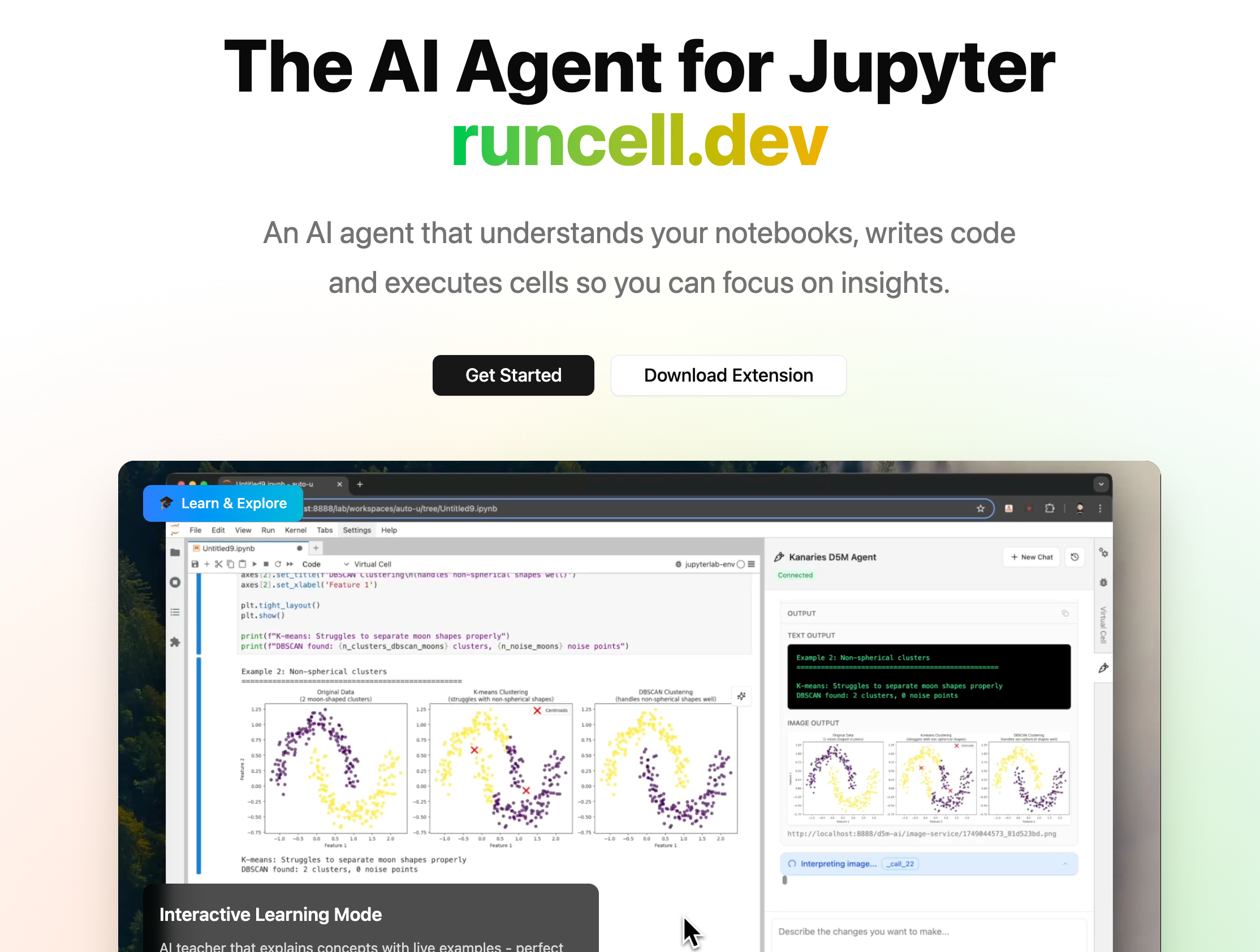
| Description | Runcell is an innovative AI agent extension purpose-built for Jupyter Lab, designed to significantly automate and enhance the entire data science and development workflow. It functions as an intelligent assistant that deeply understands the context of a notebook, enabling it to generate accurate code, debug errors, interpret complex results, and streamline analytical tasks. By integrating directly into the Jupyter environment, Runcell empowers data scientists, analysts, and developers to accelerate their work, minimize manual coding, and gain deeper insights with unprecedented efficiency, transforming Jupyter into an AI-powered co-pilot. | TensorZero is an open-source framework designed to streamline the development, deployment, and management of production-grade LLM applications. It provides a unified platform encompassing an LLM gateway, comprehensive observability, performance optimization, and robust evaluation and experimentation tools. This framework empowers developers and MLOps teams to build reliable, efficient, and scalable generative AI solutions with greater control and insight. It aims to simplify the complexities of bringing LLM projects from prototype to production by offering a structured approach to LLM operations. |
| What It Does | Runcell integrates directly into Jupyter Lab, observing and understanding the current notebook's context, data, and code. It leverages large language models (LLMs) to generate relevant Python code, identify and suggest fixes for errors, and provide natural language explanations for outputs and visualizations. Users interact with Runcell via a chat interface, prompting it to perform tasks, answer questions, or refine code directly within their existing workflow, making complex data operations more intuitive. | TensorZero functions as a middleware layer and toolkit for LLM applications, abstracting away the complexities of interacting with various LLMs and managing their lifecycle. It allows users to route requests intelligently, monitor application health and performance, optimize costs and latency, and systematically evaluate and iterate on prompts and models. By offering a programmatic interface, it integrates seamlessly into existing development workflows, enabling a robust MLOps approach for generative AI. |
| Pricing Type | free | free |
| Pricing Model | free | free |
| Pricing Plans | N/A | Community: Free |
| Rating | N/A | N/A |
| Reviews | N/A | N/A |
| Views | 51 | 60 |
| Verified | No | No |
| Key Features | N/A | N/A |
| Value Propositions | N/A | N/A |
| Use Cases | N/A | N/A |
| Target Audience | Runcell is primarily designed for data scientists, machine learning engineers, and data analysts who frequently work within Jupyter Lab. It also benefits academic researchers, students, and developers who need to quickly prototype, analyze data, and build models efficiently. Its capabilities are particularly valuable for those looking to automate repetitive coding tasks and accelerate their data-driven workflows. | This tool is ideal for MLOps engineers, AI/ML developers, and data scientists who are building, deploying, and managing production-grade LLM applications. It particularly benefits teams looking to enhance the reliability, performance, and cost-efficiency of their generative AI solutions, especially those dealing with multiple LLM providers or complex prompt engineering workflows. |
| Categories | Code & Development, Code Generation, Code Debugging, Documentation, Data Analysis, Automation, Research, Data & Analytics, Data Visualization, Data Processing | Code Debugging, Data Analysis, Analytics, Automation |
| Tags | N/A | N/A |
| GitHub Stars | N/A | N/A |
| Last Updated | N/A | N/A |
| Website | runcell.dev | www.tensorzero.com |
| GitHub | github.com | github.com |
Who is Runcell best for?
Runcell is primarily designed for data scientists, machine learning engineers, and data analysts who frequently work within Jupyter Lab. It also benefits academic researchers, students, and developers who need to quickly prototype, analyze data, and build models efficiently. Its capabilities are particularly valuable for those looking to automate repetitive coding tasks and accelerate their data-driven workflows.
Who is TensorZero best for?
This tool is ideal for MLOps engineers, AI/ML developers, and data scientists who are building, deploying, and managing production-grade LLM applications. It particularly benefits teams looking to enhance the reliability, performance, and cost-efficiency of their generative AI solutions, especially those dealing with multiple LLM providers or complex prompt engineering workflows.