
Piny vs Trudo AI

Both tools are evenly matched across our comparison criteria.
Rating
Neither tool has been rated yet.
Popularity
Trudo AI is more popular with 53 views.
Pricing
Piny is completely free.
Community Reviews
Both tools have a similar number of reviews.
| Criteria | Piny | Trudo AI |
|---|---|---|
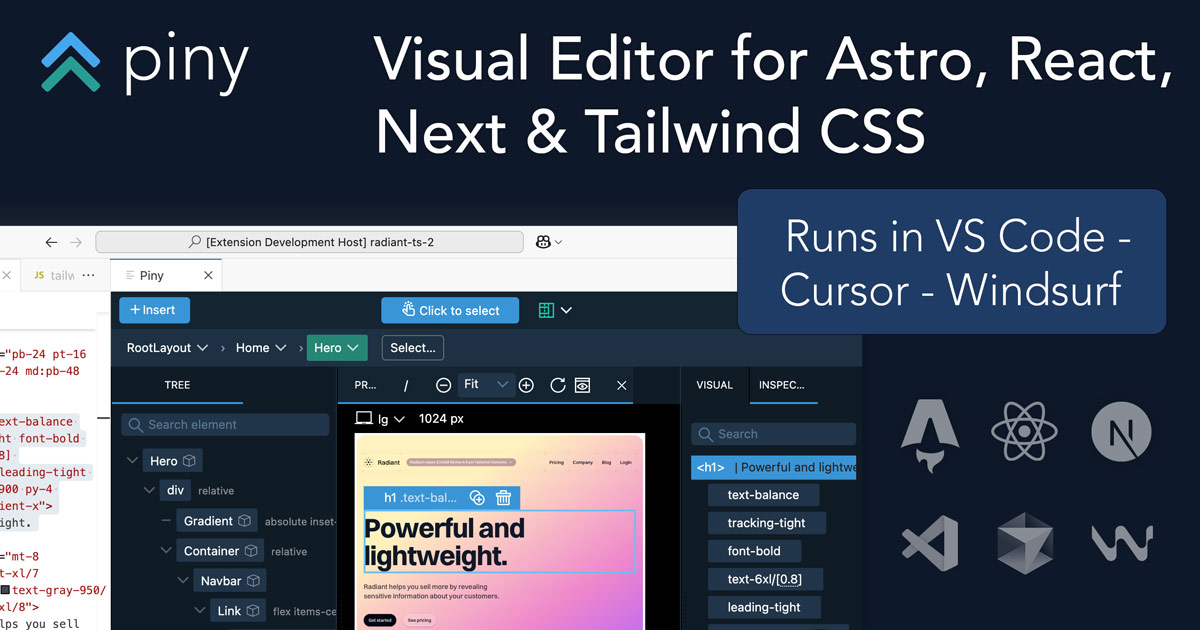
| Description | Piny is an innovative in-IDE visual editor designed to streamline UI development for modern web frameworks like Astro, React, Next.js, and Tailwind CSS. It empowers developers to directly edit components visually within their VS Code environment, dramatically accelerating the UI building process. By offering a live preview and writing changes directly to the codebase, Piny minimizes context switching and fosters seamless collaboration between designers and developers, making it a powerful tool for rapid front-end development and maintaining design system consistency. | Trudo AI is a no-code platform that empowers users to effortlessly build and deploy custom AI applications leveraging OpenAI's models. It distinguishes itself by offering robust features like fine-tuning with proprietary data and integrating long-term memory, enabling highly personalized and contextually aware conversational AI for a diverse range of business and operational needs. This allows individuals and teams, regardless of their coding expertise, to create sophisticated AI solutions that can significantly enhance customer interactions, automate tasks, and scale operations efficiently. |
| What It Does | Piny functions as a VS Code extension that provides a visual editing interface for web components. Developers can open their existing Astro, React, or Next.js projects and visually interact with components, modifying their props, children, and Tailwind CSS styles through a user-friendly GUI. All visual manipulations are translated directly into clean, readable code within the developer's files, eliminating the need for manual code translation from design mockups. | Trudo AI provides an intuitive visual interface for designing, training, and deploying AI agents. Users can upload their specific data to fine-tune OpenAI models, integrate external tools via webhooks or connectors, and establish long-term memory to maintain conversational context. The platform then allows deployment of these custom AI applications via API or embedded widgets, making complex AI accessible for various use cases. |
| Pricing Type | free | freemium |
| Pricing Model | free | freemium |
| Pricing Plans | Beta Access: Free | Free: Free, Starter: 29, Pro: 99 |
| Rating | N/A | N/A |
| Reviews | N/A | N/A |
| Views | 51 | 53 |
| Verified | No | No |
| Key Features | Direct Visual Component Editing, Real-time Live Preview, Multi-Framework Support, Native VS Code Integration, Automatic Code Generation | N/A |
| Value Propositions | Accelerated UI Development, Reduced Context Switching, Improved Designer-Developer Handoff | N/A |
| Use Cases | Rapid UI Prototyping, Building Component Libraries, Implementing Design Systems, Iterating on Existing UIs, Onboarding New Developers | N/A |
| Target Audience | Piny is primarily designed for frontend developers, UI/UX engineers, and full-stack developers working with Astro, React, Next.js, and Tailwind CSS. It's particularly beneficial for teams focused on rapid prototyping, maintaining design systems, and improving collaboration between design and development. Agencies and in-house development teams seeking to accelerate UI iteration cycles will find significant value. | Developers, businesses, and entrepreneurs seeking to build and deploy custom AI applications using OpenAI models without extensive coding. |
| Categories | Design, Code & Development, Business & Productivity, Automation | Text Generation, Code & Development, Business & Productivity, Automation |
| Tags | visual editor, vs code extension, frontend development, react, next.js, astro, tailwind css, ui building, code generation, developer tools | N/A |
| GitHub Stars | N/A | N/A |
| Last Updated | N/A | N/A |
| Website | getpiny.com | www.trudo.ai |
| GitHub | N/A | N/A |
Who is Piny best for?
Piny is primarily designed for frontend developers, UI/UX engineers, and full-stack developers working with Astro, React, Next.js, and Tailwind CSS. It's particularly beneficial for teams focused on rapid prototyping, maintaining design systems, and improving collaboration between design and development. Agencies and in-house development teams seeking to accelerate UI iteration cycles will find significant value.
Who is Trudo AI best for?
Developers, businesses, and entrepreneurs seeking to build and deploy custom AI applications using OpenAI models without extensive coding.



