Docgpt vs Runcell
Runcell wins in 2 out of 4 categories.
Rating
Neither tool has been rated yet.
Popularity
Runcell is more popular with 51 views.
Pricing
Runcell is completely free.
Community Reviews
Both tools have a similar number of reviews.
| Criteria | Docgpt | Runcell |
|---|---|---|
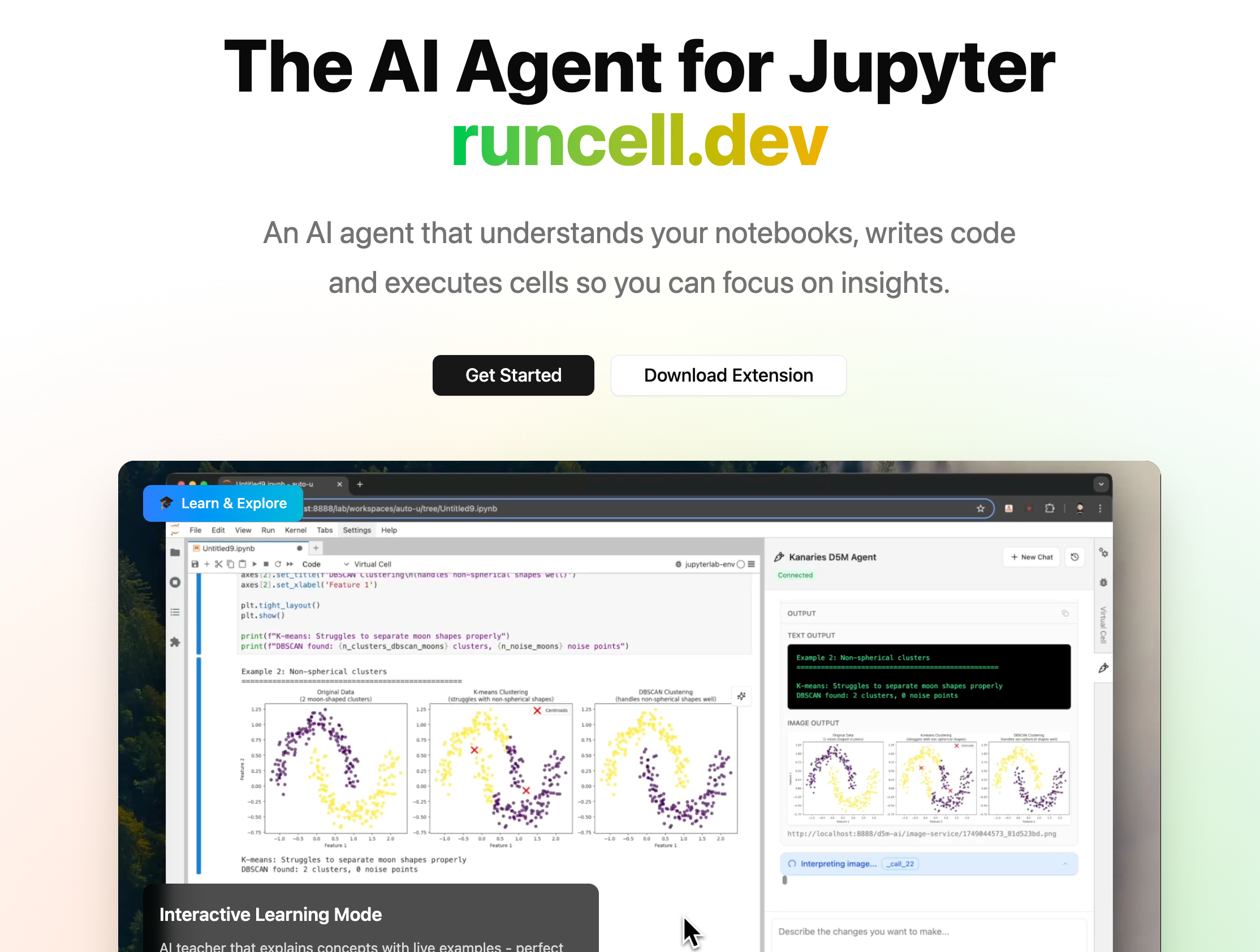
| Description | Docgpt is an innovative AI assistant that revolutionizes how users interact with PDF documents, leveraging a ChatGPT-based interface for dynamic content engagement. It empowers individuals and professionals to effortlessly upload PDFs, pose natural language questions, and receive instant, accurate answers derived directly from the document's content. Beyond simple Q&A, Docgpt excels at generating comprehensive summaries of complex texts and precisely extracting key information, transforming static documents into interactive knowledge bases. This capability significantly enhances productivity and streamlines research workflows, making even the most intricate documents easily understandable and actionable for a wide range of analytical and educational needs. | Runcell is an innovative AI agent extension purpose-built for Jupyter Lab, designed to significantly automate and enhance the entire data science and development workflow. It functions as an intelligent assistant that deeply understands the context of a notebook, enabling it to generate accurate code, debug errors, interpret complex results, and streamline analytical tasks. By integrating directly into the Jupyter environment, Runcell empowers data scientists, analysts, and developers to accelerate their work, minimize manual coding, and gain deeper insights with unprecedented efficiency, transforming Jupyter into an AI-powered co-pilot. |
| What It Does | Docgpt functions by allowing users to upload PDF documents, which it then processes using advanced AI models. Users can then ask natural language questions about the document's content, prompting the AI to generate instant, contextually relevant answers, summarize sections, or pinpoint specific data points. This process effectively transforms static PDFs into interactive knowledge bases, enabling efficient information retrieval and analysis. | Runcell integrates directly into Jupyter Lab, observing and understanding the current notebook's context, data, and code. It leverages large language models (LLMs) to generate relevant Python code, identify and suggest fixes for errors, and provide natural language explanations for outputs and visualizations. Users interact with Runcell via a chat interface, prompting it to perform tasks, answer questions, or refine code directly within their existing workflow, making complex data operations more intuitive. |
| Pricing Type | freemium | free |
| Pricing Model | freemium | free |
| Pricing Plans | Free Plan: Free, Premium Monthly: 9.99, Premium Yearly: 59.99 | N/A |
| Rating | N/A | N/A |
| Reviews | N/A | N/A |
| Views | 48 | 51 |
| Verified | No | No |
| Key Features | N/A | N/A |
| Value Propositions | N/A | N/A |
| Use Cases | N/A | N/A |
| Target Audience | This tool is ideal for students, researchers, legal professionals, business analysts, and anyone who regularly works with large volumes of PDF documents. It caters to individuals and teams needing to quickly understand, extract data from, or summarize complex textual information efficiently for academic, professional, or personal development. | Runcell is primarily designed for data scientists, machine learning engineers, and data analysts who frequently work within Jupyter Lab. It also benefits academic researchers, students, and developers who need to quickly prototype, analyze data, and build models efficiently. Its capabilities are particularly valuable for those looking to automate repetitive coding tasks and accelerate their data-driven workflows. |
| Categories | Text & Writing, Text Summarization, Business & Productivity, Research | Code & Development, Code Generation, Code Debugging, Documentation, Data Analysis, Automation, Research, Data & Analytics, Data Visualization, Data Processing |
| Tags | N/A | N/A |
| GitHub Stars | N/A | N/A |
| Last Updated | N/A | N/A |
| Website | aiforme.io | runcell.dev |
| GitHub | N/A | github.com |
Who is Docgpt best for?
This tool is ideal for students, researchers, legal professionals, business analysts, and anyone who regularly works with large volumes of PDF documents. It caters to individuals and teams needing to quickly understand, extract data from, or summarize complex textual information efficiently for academic, professional, or personal development.
Who is Runcell best for?
Runcell is primarily designed for data scientists, machine learning engineers, and data analysts who frequently work within Jupyter Lab. It also benefits academic researchers, students, and developers who need to quickly prototype, analyze data, and build models efficiently. Its capabilities are particularly valuable for those looking to automate repetitive coding tasks and accelerate their data-driven workflows.