
AI Spend vs Piny

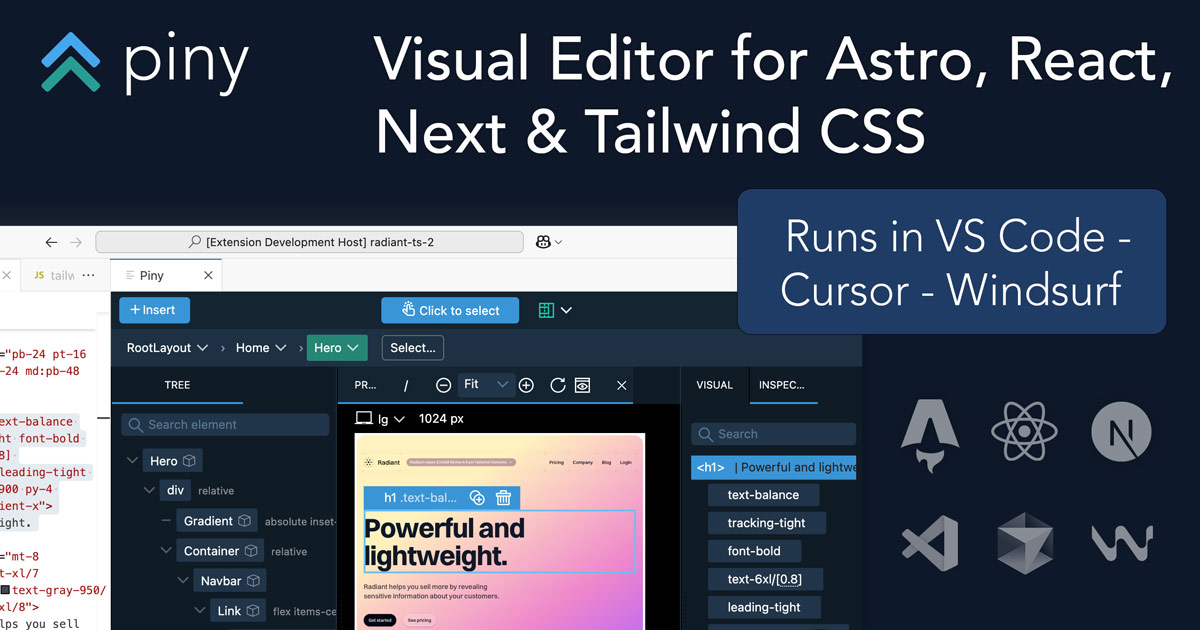
Piny wins in 2 out of 4 categories.
Rating
Neither tool has been rated yet.
Popularity
Piny is more popular with 51 views.
Pricing
Piny is completely free.
Community Reviews
Both tools have a similar number of reviews.
| Criteria | AI Spend | Piny |
|---|---|---|
| Description | AI Spend is a specialized AI tool designed to monitor and optimize OpenAI API costs for businesses and developers. It provides real-time usage insights, customizable alerts, and budget management features to prevent unexpected bills and ensure efficient resource allocation. By offering detailed cost breakdowns across projects, models, and users, AI Spend empowers organizations to maintain control over their AI infrastructure expenses and make informed decisions about API consumption. | Piny is an innovative in-IDE visual editor designed to streamline UI development for modern web frameworks like Astro, React, Next.js, and Tailwind CSS. It empowers developers to directly edit components visually within their VS Code environment, dramatically accelerating the UI building process. By offering a live preview and writing changes directly to the codebase, Piny minimizes context switching and fosters seamless collaboration between designers and developers, making it a powerful tool for rapid front-end development and maintaining design system consistency. |
| What It Does | The tool connects directly to a user's OpenAI API key (read-only) to track usage and spending in real-time. It processes this data to generate comprehensive analytics, allowing users to visualize costs by various dimensions like models, projects, and individual users. AI Spend also facilitates the setting of budget limits and sends automated notifications via email or Slack when thresholds are approached or exceeded, ensuring proactive cost management. | Piny functions as a VS Code extension that provides a visual editing interface for web components. Developers can open their existing Astro, React, or Next.js projects and visually interact with components, modifying their props, children, and Tailwind CSS styles through a user-friendly GUI. All visual manipulations are translated directly into clean, readable code within the developer's files, eliminating the need for manual code translation from design mockups. |
| Pricing Type | freemium | free |
| Pricing Model | freemium | free |
| Pricing Plans | Free: Free, Pro: 29, Enterprise: Custom | Beta Access: Free |
| Rating | N/A | N/A |
| Reviews | N/A | N/A |
| Views | 39 | 51 |
| Verified | No | No |
| Key Features | Real-time Usage Monitoring, Customizable Budget Limits, Detailed Cost Breakdown, Automated Alerts & Notifications, Spend Forecasting | Direct Visual Component Editing, Real-time Live Preview, Multi-Framework Support, Native VS Code Integration, Automatic Code Generation |
| Value Propositions | Prevent Unexpected API Bills, Optimize AI Spending, Enhance Financial Transparency | Accelerated UI Development, Reduced Context Switching, Improved Designer-Developer Handoff |
| Use Cases | Managing Multi-Project API Costs, Preventing Bill Shock for Startups, Optimizing Model Usage Efficiency, Monitoring Team API Consumption, Forecasting Future AI Expenditures | Rapid UI Prototyping, Building Component Libraries, Implementing Design Systems, Iterating on Existing UIs, Onboarding New Developers |
| Target Audience | This tool is ideal for developers, startups, product teams, and enterprises that heavily utilize OpenAI APIs for their applications and services. It caters to anyone looking to gain better visibility, control, and optimization over their AI-related infrastructure costs, from individual project managers to finance departments. | Piny is primarily designed for frontend developers, UI/UX engineers, and full-stack developers working with Astro, React, Next.js, and Tailwind CSS. It's particularly beneficial for teams focused on rapid prototyping, maintaining design systems, and improving collaboration between design and development. Agencies and in-house development teams seeking to accelerate UI iteration cycles will find significant value. |
| Categories | Business & Productivity, Data Analysis, Analytics, Automation | Design, Code & Development, Business & Productivity, Automation |
| Tags | openai api, cost management, api monitoring, ai spend, usage tracking, budgeting, cost optimization, developer tools, finops, ai analytics | visual editor, vs code extension, frontend development, react, next.js, astro, tailwind css, ui building, code generation, developer tools |
| GitHub Stars | N/A | N/A |
| Last Updated | N/A | N/A |
| Website | aispend.io | getpiny.com |
| GitHub | N/A | N/A |
Who is AI Spend best for?
This tool is ideal for developers, startups, product teams, and enterprises that heavily utilize OpenAI APIs for their applications and services. It caters to anyone looking to gain better visibility, control, and optimization over their AI-related infrastructure costs, from individual project managers to finance departments.
Who is Piny best for?
Piny is primarily designed for frontend developers, UI/UX engineers, and full-stack developers working with Astro, React, Next.js, and Tailwind CSS. It's particularly beneficial for teams focused on rapid prototyping, maintaining design systems, and improving collaboration between design and development. Agencies and in-house development teams seeking to accelerate UI iteration cycles will find significant value.



