

Monkt
Last updated:
Monkt is an advanced AI tool designed to transform diverse unstructured documents, such as PDFs, DOCX files, HTML pages, and images, into clean, structured Markdown or JSON formats. It acts as a crucial pre-processing layer for AI and LLM integration, enabling these models to efficiently consume and utilize information. By streamlining data preparation, Monkt significantly enhances workflows for AI model training, fine-tuning, Retrieval Augmented Generation (RAG), and sophisticated prompt engineering, addressing the critical challenge of feeding structured data to intelligent systems.
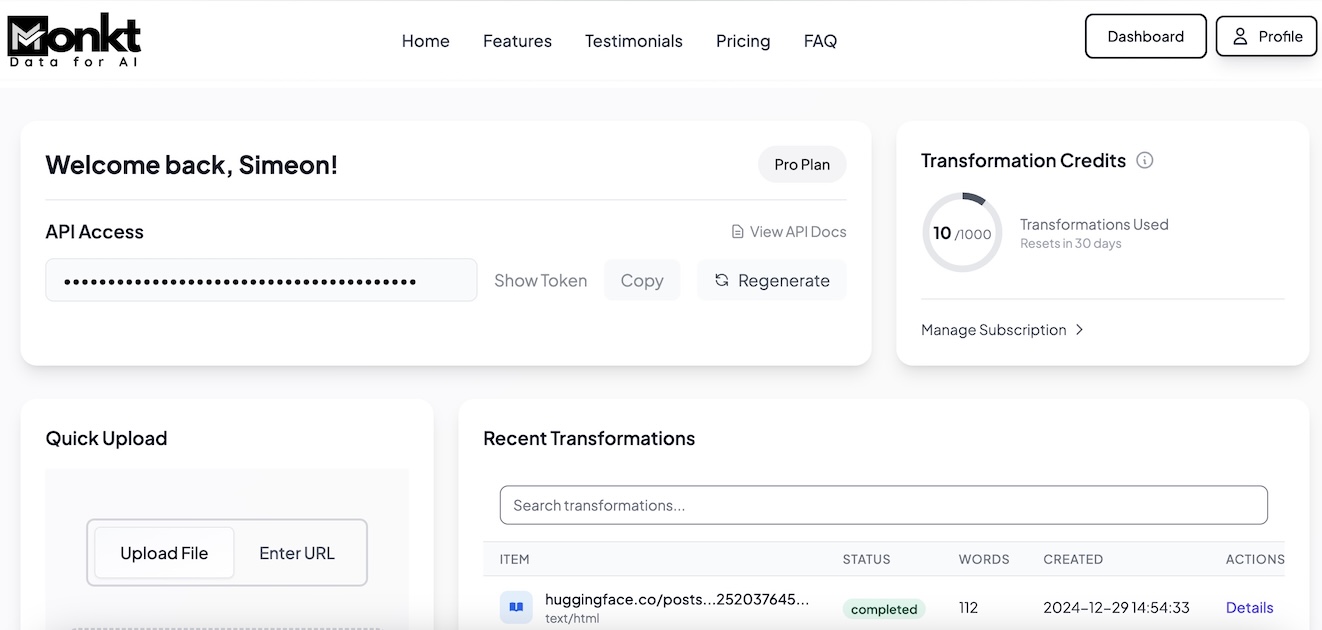
What It Does
Monkt's core functionality involves ingesting various document types, performing intelligent layout analysis, and extracting content including text, tables, and images. It then converts this raw, unstructured data into highly organized Markdown or JSON formats, making it readily consumable by AI models. This process effectively bridges the gap between human-readable documents and AI-parsable data structures.
Pricing
Core Value Propositions
Accelerate AI Development
Streamlines data preparation, allowing developers to build and deploy AI applications faster by providing structured, ready-to-use data.
Enhance LLM Performance
Feeds AI models with high-quality, structured input, leading to more accurate responses, better training, and improved fine-tuning results.
Automate Data Pre-processing
Eliminates manual, tedious document parsing and structuring, saving significant time and resources for AI teams.
Improve Data Consistency
Ensures uniform data output from diverse document types, crucial for reliable and scalable AI systems.
Use Cases
RAG System Data Preparation
Convert enterprise documents (manuals, reports) into structured data for Retrieval Augmented Generation, powering intelligent chatbots and search.
LLM Fine-tuning Datasets
Prepare proprietary documents into clean, structured datasets for fine-tuning custom large language models on specific domain knowledge.
Automated Prompt Engineering
Extract structured information from internal knowledge bases to automatically generate high-quality, context-rich prompts for AI applications.
Intelligent Document Processing
Automate the extraction of key information (e.g., contracts, invoices) into structured JSON for downstream business process automation and analytics.
Research and Analysis
Structure academic papers, legal documents, or research reports to enable AI-powered analysis, summarization, and knowledge graph creation.
Technical Features & Integration
Multi-format Document Parsing
Processes PDFs, DOCX, HTML, TXT, and images (via OCR), extracting all relevant content from diverse sources.
Intelligent Layout Analysis
Accurately detects and preserves document structure, including headings, paragraphs, lists, and tables, ensuring semantic integrity.
Structured Output Generation
Transforms extracted content into clean, AI-ready Markdown or JSON, optimized for LLM consumption.
Customizable Output Schema
Allows users to define specific rules and structures for the output, tailoring data to unique AI model requirements.
API-First Integration
Offers a robust API for seamless integration into existing applications and automated data pipelines, enhancing developer productivity.
Robust Error Handling
Designed to manage complex or malformed documents gracefully, ensuring reliable data extraction even with challenging inputs.
Target Audience
Monkt is primarily aimed at AI developers, data scientists, machine learning engineers, and researchers who build or work with LLM-powered applications. It is invaluable for companies and teams focused on AI model training, fine-tuning, Retrieval Augmented Generation (RAG), and prompt engineering, particularly those dealing with large volumes of unstructured document data.
Frequently Asked Questions
Monkt is a paid tool.
Monkt's core functionality involves ingesting various document types, performing intelligent layout analysis, and extracting content including text, tables, and images. It then converts this raw, unstructured data into highly organized Markdown or JSON formats, making it readily consumable by AI models. This process effectively bridges the gap between human-readable documents and AI-parsable data structures.
Key features of Monkt include: Multi-format Document Parsing: Processes PDFs, DOCX, HTML, TXT, and images (via OCR), extracting all relevant content from diverse sources.. Intelligent Layout Analysis: Accurately detects and preserves document structure, including headings, paragraphs, lists, and tables, ensuring semantic integrity.. Structured Output Generation: Transforms extracted content into clean, AI-ready Markdown or JSON, optimized for LLM consumption.. Customizable Output Schema: Allows users to define specific rules and structures for the output, tailoring data to unique AI model requirements.. API-First Integration: Offers a robust API for seamless integration into existing applications and automated data pipelines, enhancing developer productivity.. Robust Error Handling: Designed to manage complex or malformed documents gracefully, ensuring reliable data extraction even with challenging inputs..
Monkt is best suited for Monkt is primarily aimed at AI developers, data scientists, machine learning engineers, and researchers who build or work with LLM-powered applications. It is invaluable for companies and teams focused on AI model training, fine-tuning, Retrieval Augmented Generation (RAG), and prompt engineering, particularly those dealing with large volumes of unstructured document data..
Streamlines data preparation, allowing developers to build and deploy AI applications faster by providing structured, ready-to-use data.
Feeds AI models with high-quality, structured input, leading to more accurate responses, better training, and improved fine-tuning results.
Eliminates manual, tedious document parsing and structuring, saving significant time and resources for AI teams.
Ensures uniform data output from diverse document types, crucial for reliable and scalable AI systems.
Convert enterprise documents (manuals, reports) into structured data for Retrieval Augmented Generation, powering intelligent chatbots and search.
Prepare proprietary documents into clean, structured datasets for fine-tuning custom large language models on specific domain knowledge.
Extract structured information from internal knowledge bases to automatically generate high-quality, context-rich prompts for AI applications.
Automate the extraction of key information (e.g., contracts, invoices) into structured JSON for downstream business process automation and analytics.
Structure academic papers, legal documents, or research reports to enable AI-powered analysis, summarization, and knowledge graph creation.



Get new AI tools weekly
Join readers discovering the best AI tools every week.