
Build Your Own AI vs Magick

Magick wins in 1 out of 4 categories.
Rating
Neither tool has been rated yet.
Popularity
Both tools have similar popularity.
Pricing
Build Your Own AI uses paid pricing while Magick uses freemium pricing.
Community Reviews
Both tools have a similar number of reviews.
| Criteria | Build Your Own AI | Magick |
|---|---|---|
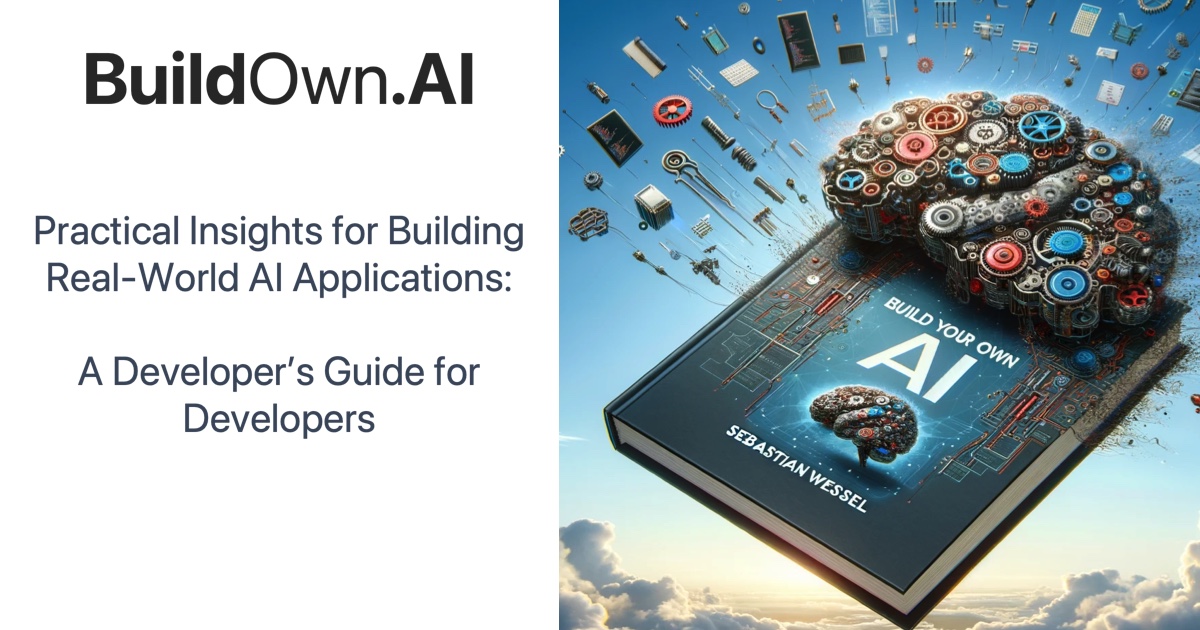
| Description | Build Your Own AI is a comprehensive, practical guide for developers seeking to master the creation of real-world AI applications using Python. Authored by a Google Senior Staff Software Engineer and published by Manning, this book covers essential modern AI concepts like Large Language Models (LLMs), Retrieval Augmented Generation (RAG), and AI agents. It emphasizes hands-on code examples and project-based learning to bridge the gap between theoretical knowledge and practical application, enabling developers to build, deploy, and monitor robust AI systems. | Magick is a visual low-code Integrated Development Environment (IDE) specifically designed for building, testing, and deploying custom AI agents and applications. It provides an intuitive drag-and-drop interface that streamlines complex AI workflows, enabling developers and teams to visually orchestrate various AI models and external tools. This platform empowers users to create sophisticated agent behaviors, rapidly iterate on their designs, and deploy scalable AI solutions, significantly accelerating innovation in AI development. |
| What It Does | This tool, presented as a book, serves as an educational resource that teaches developers how to design, build, and deploy AI applications. It provides structured learning modules, detailed explanations of core AI concepts, and practical Python code examples. The guide walks users through creating functional AI projects from scratch, covering everything from foundational Python skills to advanced deployment strategies. | Magick functions as a visual canvas where users connect 'nodes' representing AI models, data sources, and logical operations to construct intricate AI workflows. It facilitates the seamless integration of diverse AI models, including large language models (LLMs) and custom APIs, allowing users to design, test, debug, and deploy custom AI agents. These agents can then be exposed as scalable API endpoints, ready for production use. |
| Pricing Type | paid | freemium |
| Pricing Model | paid | freemium |
| Pricing Plans | eBook: 39.99, Print Book: 49.99, eBook + Print Book: 59.99 | Free: Free, Pro: 29, Enterprise: Custom |
| Rating | N/A | N/A |
| Reviews | N/A | N/A |
| Views | 45 | 45 |
| Verified | No | No |
| Key Features | LLM & Prompt Engineering, Retrieval Augmented Generation (RAG), AI Agents & Multi-Agent Systems, Practical Python Code Examples, Project-Based Learning | N/A |
| Value Propositions | Practical Skill Development, Real-World Project Experience, Master Modern AI Techniques | N/A |
| Use Cases | Building Intelligent Chatbots, Creating Semantic Search Engines, Developing Autonomous AI Agents, Constructing Code Assistants, Implementing RAG for Knowledge Bases | N/A |
| Target Audience | This guide is ideal for software developers, data scientists, and AI/ML engineers who want to acquire practical skills in building and deploying modern AI applications. It caters to those with a foundational understanding of Python looking to specialize in LLMs, RAG, and AI agents. Students and hobbyists eager to transition theoretical AI knowledge into tangible projects will also find it highly beneficial. | This tool is ideal for AI developers, machine learning engineers, product managers, and innovation teams focused on rapidly prototyping, building, and deploying custom AI agents and applications. It particularly benefits those needing to integrate multiple AI models and complex logic into their solutions without heavy coding, accelerating their development cycles. |
| Categories | Code & Development, Learning, Education & Research | Code & Development, Code Generation, Automation |
| Tags | python, llms, rag, ai agents, machine learning, deep learning, ai development, project-based learning, software engineering, ai deployment, developer guide | N/A |
| GitHub Stars | N/A | N/A |
| Last Updated | N/A | N/A |
| Website | buildown.ai | www.magickml.com |
| GitHub | github.com | github.com |
Who is Build Your Own AI best for?
This guide is ideal for software developers, data scientists, and AI/ML engineers who want to acquire practical skills in building and deploying modern AI applications. It caters to those with a foundational understanding of Python looking to specialize in LLMs, RAG, and AI agents. Students and hobbyists eager to transition theoretical AI knowledge into tangible projects will also find it highly beneficial.
Who is Magick best for?
This tool is ideal for AI developers, machine learning engineers, product managers, and innovation teams focused on rapidly prototyping, building, and deploying custom AI agents and applications. It particularly benefits those needing to integrate multiple AI models and complex logic into their solutions without heavy coding, accelerating their development cycles.


